
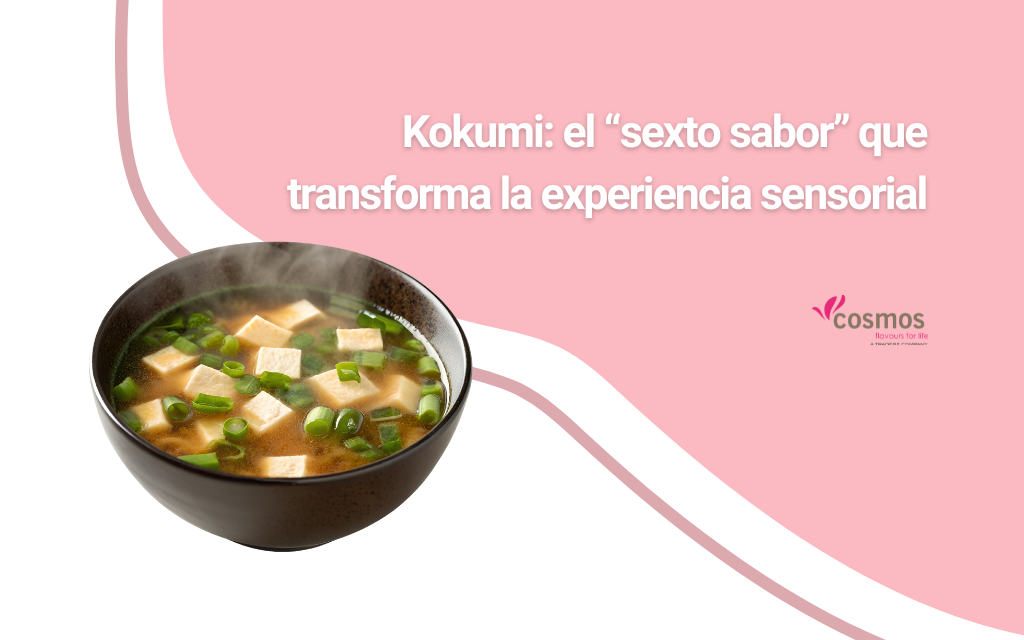
There are flavours that are hard to describe. They are neither sweet nor salty, neither bitter nor sour, yet they possess something that makes them irresistible. It’s that sensation of depth, body, and richness that envelops the palate and lingers in the mouth. The Japanese found a word to define this unique gustatory experience: kokumi.
At Cosmos Aromática, with decades of experience in designing and manufacturing aromatic and flavour solutions for food (including beverages, dairy and bakery), as well as for cosmetics, pharmaceuticals and perfumery, we explore what kokumi is and how it works.
What is the kokumi taste?
When we talk about kokumi, we are not referring to a new taste per se, but rather an effect on the flavours already present. Scientific and popular literature defines it as a sensation of richness, fullness, and continuity of flavour that fills the mouth and prolongs the tasting experience.
Put simply, kokumi has no taste of its own. It is neither sweet, salty, nor sour. Its role is to intensify and extend other flavours and enhance the mouthfeel.
For this reason, kokumi is often described as a “palatability enhancer”: the dish feels more complete, more “full,” without the need to add extra salt, sugar, or fat.
What does “kokumi” mean in Japanese?
The term comes from two Japanese components:
- koku: rich, deep flavour
- mi: taste
“Kokumi” is usually translated as “rich taste,” “full flavour,” or “mouthfulness,” meaning a sensation of fullness in the mouth.
Origin and scientific discovery
Although Japanese chefs had spoken for decades about “koku” to describe the fullness of certain broths, it was in the 1980s and 1990s that the Ajinomoto group began systematically investigating which substances produced this sensation in foods such as garlic and onion.
Using plant-based extracts, particularly from yeast and vegetables, the R&D team identified that certain peptides were linked to this sensation of body and flavour persistence.
In 1990, they launched a flavour modifier based on glutathione, marketed as yeast extract for the food industry, and from there the study expanded to other peptides with similar activity.
Peptides responsible: glutathione and γ-glutamyl peptides
The first compounds associated with kokumi were:
- Glutathione (GSH): a tripeptide formed by glutamic acid, cysteine, and glycine
- γ-Glutamyl peptides, such as γ-Glu-Val-Gly (γ-EVG)
These peptides have two key characteristics:
- They activate the calcium-sensing receptor (CaSR) present in certain taste cells.
- When added to foods rich in umami, sweet, or salty flavours, they enhance the perception of fullness and prolong the duration of the taste.
In fact, correlation studies have shown that the greater the activity of these peptides on the CaSR, the higher the sensory intensity associated with kokumi.
What does kokumi taste like?
When trained tasters are asked to describe kokumi, a series of recurring terms appear:
- A sensation of a “full” mouth, or mouthfulness.
- A thicker or creamier texture.
- A more “rounded” and balanced flavour.
- Prolonged persistence of taste and aroma.
Rather than a single, distinct flavour impact, kokumi is perceived as an additional layer that envelops the entire dish, making it more satisfying and extending the aftertaste.
Foods naturally rich in kokumi
Research has identified several foods that contain compounds associated with kokumi, particularly glutathione and γ-glutamyl peptides:
- Cooked garlic and onion: Ueda and colleagues showed that aqueous garlic extracts enhanced umami intensity, leading to the identification of glutathione as a kokumi-active substance.
- Aged cheeses: During maturation, γ-glutamyl peptides are generated, increasing the sensation of body and continuity of flavour.
- Soy sauce and miso: Long fermentations promote the formation of kokumi peptides, which complement the umami of free amino acids and nucleotides.
- Seafood: Particularly scallops, where γ-EVG has been identified as one of the most potent kokumi peptides.
- Slow-cooked broths and stews: Extended cooking releases and transforms peptides present in meat, bones, and vegetables, explaining the “homemade broth” sensation full of flavour.
Kokumi in modern gastronomy
For chefs and product developers, kokumi offers an exciting opportunity: creating dishes and formulations that are more flavourful and with a better perceived texture, without increasing salt or fat content.
The industry uses kokumi substances, such as yeast extracts rich in glutathione or γ-glutamyl peptides, to:
- Enhance creaminess in low-fat sauces and creams.
- Compensate for salt reductions in broths, soups, or meat products.
- Improve flavour perception in plant-based meat alternatives.
This aligns with current trends: fewer artificial additives, reformulations with lower salt and fat, and greater attention to clean labels.
Kokumi and the trend towards natural flavours
Technical literature highlights the industry’s interest in using ingredients that provide kokumi from natural sources (fermentations, yeast extracts, vegetable concentrates), in line with clean label concepts and shorter formulations.
For flavour manufacturers offering tailored solutions for dairy, beverages, bakery, and savoury applications, kokumi becomes a key focus in designing flavour profiles that allow:
- Maintaining taste intensity in “reformulated” versions.
- Improving perceived texture and mouthfeel.
- Delivering differentiated gustatory experiences for both B2B and B2C products.
Is kokumi essential for a good meal?
From a food engineering perspective, it’s important to clarify: a dish does not need a high level of kokumi to be enjoyable. Basic tastes, aromas, texture, and temperature can already create a satisfying experience.
However, kokumi becomes a valuable ally when aiming for:
- Comforting dishes such as stews, broths, creams, and casseroles.
- Cheeses, sauces, and fermented products with strong character.
- Processed foods with reduced salt, sugar, or fat, yet still perceived as flavorful by consumers.
In other words, kokumi alone does not determine whether a meal is good, but it can make the difference between a decent product and one that feels rounded, balanced, and highly satisfying. For brands seeking customer loyalty, this translates into higher repeat purchases and better sensory ratings.
Is kokumi similar to monosodium glutamate (MSG)?
On one hand, monosodium glutamate (MSG) has been used for decades to enhance umami in soups, sauces, and snacks. It is a salt of glutamic acid and acts on specific umami receptors (T1R1/T1R3 and mGluR4).
Kokumi, on the other hand, is associated with peptides such as glutathione and γ-glutamyl peptides. It acts on the CaSR receptor, not the typical umami receptors, and does not contribute a recognisable taste of its own.
Therefore, although both are used as “flavour enhancers,” their chemical nature, receptors, and sensory impact are distinct.
Are there kokumi flavour enhancers?
Kokumi substances are defined as compounds that, although virtually tasteless at their usage levels, enhance the complexity, fullness, and duration of flavour when added to a food. The most studied families include:
- Glutathione and other γ-glutamyl peptides.
- Certain compounds derived from fermentations (for example, in soy-based foods).
- Extracts of garlic, onion, and yeast that have demonstrated activity on the CaSR receptor.
Kokumi ingredients for the food industry
Today, various ingredient suppliers offer:
- Yeast extracts enriched with glutathione.
- γ-Glutamyl peptide blends designed for specific applications (meat products, snacks, plant-based alternatives).
- Solutions combining umami notes and kokumi activity for reformulations with reduced salt or fat.
These are especially used in:
- Concentrated broths and soups.
- Sauces and dressings.
- Meat products and plant-based analogues.
- Savoury snacks and ready-to-eat meals.
Kokumi: the taste of fullness applied to your developments
Kokumi explains why certain foods feel especially rounded and memorable. It does not add a new taste but reinforces the intensity, richness, and duration of existing flavours.
For brands aiming to differentiate themselves, understanding and using kokumi opens the door to designing products with a greater sense of quality and craftsmanship, supporting healthy reformulation strategies without sacrificing pleasure, and offering gustatory experiences that meet the expectations of both culinary professionals and consumers.
Would you like to innovate and develop new products? At Cosmos Aromática, we work with you to conceptualise and design launches or improve existing formulations, taking your business to the next level.
Get in touch with our team and discover a new way to create flavours that captivate the senses.